📞 Get free knowledge of Sanatan from our Sanatani Specialists. Call now +91 9667354266
Bagalamukhi Mata arti
Dhanadalakshmi Stotram
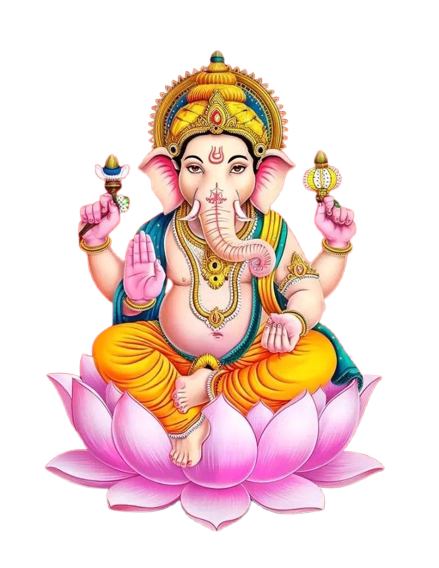
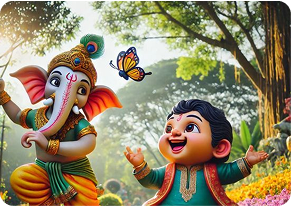
Lord Ganesha, also known as Ganapati, Vinayaka, or Vighnaharta, is one of the most revered deities in Hinduism. Recognized as the remover of obstacles, patron of arts and sciences, and god of wisdom and beginnings, Ganesha is worshipped at the start of rituals and ceremonies. He is the son of Lord Shiva and Goddess Parvati.
Lord Ganesha is embodiment of three virtues namely Buddhi, Siddhi and Riddhi known as wisdom, spirituality and prosperity respectively. Lord Ganesha is the personification of Buddhi Himself. The other two virtues are personified as Goddesses and considered to be the consorts of Lord Ganesha. Most of the art works show Ganesha flanked by two consorts who are named as Riddhi and Siddhi. It is believed that Riddhi and Siddhi were daughters of Lord Brahma who himself had conducted wedding ceremony of Lord Ganesha.
As per Shiva Purana, Lord Ganesha had two sons who were named as Shubh and Labh. Shubh and Labh are personification of auspiciousness and profit respectively. Shubh was the son of Goddess Riddhi and Labh was the son of Goddess Siddhi.
Lord Ganesha is typically depicted with:
An elephant head symbolizing wisdom and understanding.
A large belly, representing generosity and the capacity to digest all experiences.
Four arms, holding items like a noose (pāśa), goad (aṅkuśa), modaka (sweet), and a broken tusk.
His vahana (vehicle) is a mouse, symbolizing humility and the ability to overcome desires.
Lord Ganesha is said to have taken multiple forms to fulfill divine purposes. Prominent avatars include:
Vakratunda: The curved trunk form, destroyer of arrogance.
Ekadanta: One with a single tusk, symbolizing sacrifice.
Mahodara: The great-bellied, symbolizing universality.
Gajanana: The elephant-faced form, embodying power and intellect.
These and others are detailed in the Mudgala Purana and Ganesha Purana.